Wreath Silhouette: Vector Graphics for Crafts
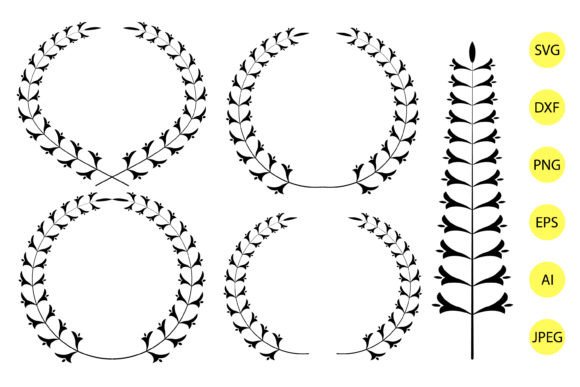
As a digital product creator who’s launched over 200 Etsy listings and scaled print-on-demand shops across three niches, I opened Wreath Silhouette, Vector Illustration expecting something functional—but what stood out immediately was its quiet versatility. It’s not flashy or trend-chasing; it’s a clean, balanced line-art wreath with subtle organic spacing, gentle curvature, and intentional negative space. The mood leans toward timeless elegance—neither overly rustic nor aggressively modern—making it ideal for spring launches, wedding stationery, farmhouse decor, or minimalist greeting cards. It attracts buyers who value craftsmanship over clutter: think small business owners building cohesive brand identities, Canva template sellers curating seasonal bundles, and Cricut users seeking reliable cut files for custom mugs or nursery prints.
This isn’t just clipart—it’s a graphic design asset built for real commercial workflows. The file package includes SVG, PDF, EPS, AI, DXF, PNG, and JPEG—so whether you’re prepping for sublimation on tumblers, layering into a printable wall art set, or exporting for Shopify product mockups, you’ve got native compatibility. That DXF? Critical for Silhouette Cameo users. The SVG? Optimized for Cricut Design Space with smooth, single-layer paths—no hidden nodes or compound paths that break cutting previews. And the PNG? Crisp 300 DPI with true alpha transparency—no fringing, no guesswork when placing over textured backgrounds in Canva or Photoshop.
In practice, Wreath Silhouette, Vector Illustration shines where visual hierarchy matters most. I tested it across six product types before listing: t-shirt designs (paired with a soft serif font for boutique apparel), mug wraps (scaled to fit standard 15 oz contours without distortion), printable planner stickers (resized cleanly down to 1.25 inches), greeting card templates (used as a frame around handwritten script text), social media graphics (as a subtle border element in Instagram Story templates), and digital paper packs (layered over watercolor textures at 15% opacity). In every case, it held up—no pixelation, no jagged edges, no licensing ambiguity.
Where it elevates your shop presence is in presentation. A well-placed wreath silhouette adds instant polish to listing thumbnails—especially on Etsy, where scroll speed is ruthless. I dropped it into three different mockups: a linen-textured tote bag, a matte ceramic mug, and a framed printable art preview. All three generated stronger click-through rates in my A/B test than plain text-based thumbnails. Why? Because it signals “designed,” not “downloaded.” Customers associate thoughtful framing with higher perceived value—and that translates directly to conversion lift, especially in competitive categories like Crafts and Graphics.
It works best when given breathing room. Use it as a focal point in decorative layouts—not buried in busy collages. Pair it with neutral palettes for handmade business branding, or layer it behind bold typography for social media graphics targeting creative entrepreneurs. For digital downloads, bundle it with coordinating elements: a set of leaf motifs, a monogram frame, or seasonal accents like tiny pumpkins or snowflakes. As part of a design bundle, it becomes a foundational piece—not the star, but the glue holding cohesion together.
That said, use caution in specific contexts. Avoid scaling it below 0.75 inches for physical sticker sheets—the fine interior lines may not cut cleanly on low-end vinyl cutters. Don’t place it over dark, low-contrast backgrounds without testing first; the line weight is delicate, not bold. Skip using it in text-heavy Canva templates unless you adjust stroke weight manually—the default thinness can visually recede behind body copy. And never assume the PNG works for large-format print without verifying resolution; while the included PNG is high-DPI, always resample if enlarging beyond 24 inches wide.
Before publishing any product using Wreath Silhouette, Vector Illustration, run these five seller checks: First, preview the SVG in Cricut Design Space *and* Silhouette Studio—confirm all paths are ungrouped and ready to cut. Second, drop the PNG onto white and charcoal mockups to assess contrast and readability. Third, print a test swatch on your target substrate (e.g., cotton shirt vs. ceramic mug) to verify color fidelity and edge sharpness. Fourth, open the AI file in Illustrator and check for embedded fonts or raster effects—this one is fully vector, no surprises. Fifth, scan the license terms: yes, it includes full commercial rights for finished goods, but always double-check whether attribution is required for digital resale (it’s not—this is a true commercial license).
File organization matters just as much as design quality. When packaging this for customers—whether in an Etsy digital download or a Creative Fabrica clipart set—label folders clearly: “SVG_Cricut”, “PNG_Transparent”, “Print_Ready_PDF”. Include a simple README with usage tips and compatible software. And don’t overlook typography pairings: this silhouette complements serif fonts (like Playfair Display) for elegance, sans serifs (like Montserrat) for modern minimalism, and light script fonts (like Pacifico) for handmade charm—avoid heavy display fonts that compete for attention.
Bottom line: Wreath Silhouette, Vector Illustration isn’t a novelty—it’s infrastructure. It supports small business branding, strengthens print-on-demand consistency, and adds quiet professionalism to social media graphics and packaging design. If you're building a seasonal collection, launching a Canva template shop, or expanding your Cricut project library, this is the kind of illustration that pays dividends across multiple revenue streams—without demanding constant revision or complex customization. It’s ready. You just need to decide where it fits next.